
Lavaca Parole Versus Probation
Parole and mandatory supervision follow confinement in the Texas Department of Criminal Justice. The Texas Board of Pardons and Paroles makes release decisions, while the TDCJ Parole Division administers the conditions after release. Probation, called community supervision in many Texas records, is imposed by a trial court and managed by the local community supervision and corrections department. It can replace incarceration. Thus, a probation order does not show that the person first served a TDCJ sentence.
The source of the order is the clearest dividing line. A TDCJ number, Board result, and state release record point toward parole or mandatory supervision. A Lavaca court judgment that places a person on community supervision points toward probation. Neither status should be inferred from a name leaving the current jail roster.
| Status | Who orders it | Lavaca County verification |
|---|---|---|
| Parole | Texas Board of Pardons and Paroles | TDCJ result, actual release status, then Victoria DPO |
| Mandatory supervision | Texas law and Board process | TDCJ record, Board result, and state IVSS |
| Probation | Sentencing court | Court judgment plus 2nd 25th Judicial District CSCD |
| Full discharge | Sentence and agency record | Final discharge or completion record, with no active supervision assumed |
- Parole
- Conditional release from a TDCJ sentence before the full sentence ends.
- Probation
- Court-ordered community supervision that may be imposed instead of confinement.
- Mandatory supervision
- A statutory form of supervised state release, subject to eligibility rules and Board review.
- Discharge
- The recorded end of a sentence or supervision term.
Verify Lavaca Post-Release Supervision
Begin with the custody system, not a guess about the status. The TDCJ inmate search covers people currently incarcerated in a state facility and can show a projected release date. It is not a universal archive of discharged people. If the person no longer appears, request incarceration history from TDCJ and compare it with the Board result, the court judgment, and the actual release record.
- Match the person by full name and a TDCJ or SID number when available. Names alone can identify the wrong person.
- Establish whether the person was actually in TDCJ custody or only in the Lavaca County Jail.
- Check the Board review result. A favorable vote is not proof that physical release occurred.
- For a favorable vote, call TDCJ Release Processing at 512-406-5202 and confirm the actual state release status.
- Use the Victoria DPO only after state parole or mandatory supervision is supported. For probation, obtain the court order and contact the local CSCD.
Before a Board vote, the official review-status line is 844-512-0461. General location information is available from TDCJ at 936-295-6371 or 800-535-0283 on weekdays from 8 a.m. to 5 p.m. Callers need a TDCJ or SID number or the exact date of birth. These channels answer different stages, so a pre-vote call should not be treated as post-vote release proof.
The Lavaca County released inmate search and records path can establish the end of a county-jail booking. It cannot by itself establish state parole or local probation.
Lavaca Supervision Office Split
Lavaca County has a clear geographic and legal split. State parole cases are assigned outside the county to the Victoria District Parole Office in TDCJ Region IV. Local adult probation is managed in Hallettsville by the 2nd 25th Judicial District department, which serves Lavaca, Gonzales, and Colorado counties. The two offices do not confirm the same status.
The official TDCJ county assignment shows Lavaca routed to Victoria. The image below captures that statewide routing source. It should be read as an office assignment, not proof that a named person reports there.
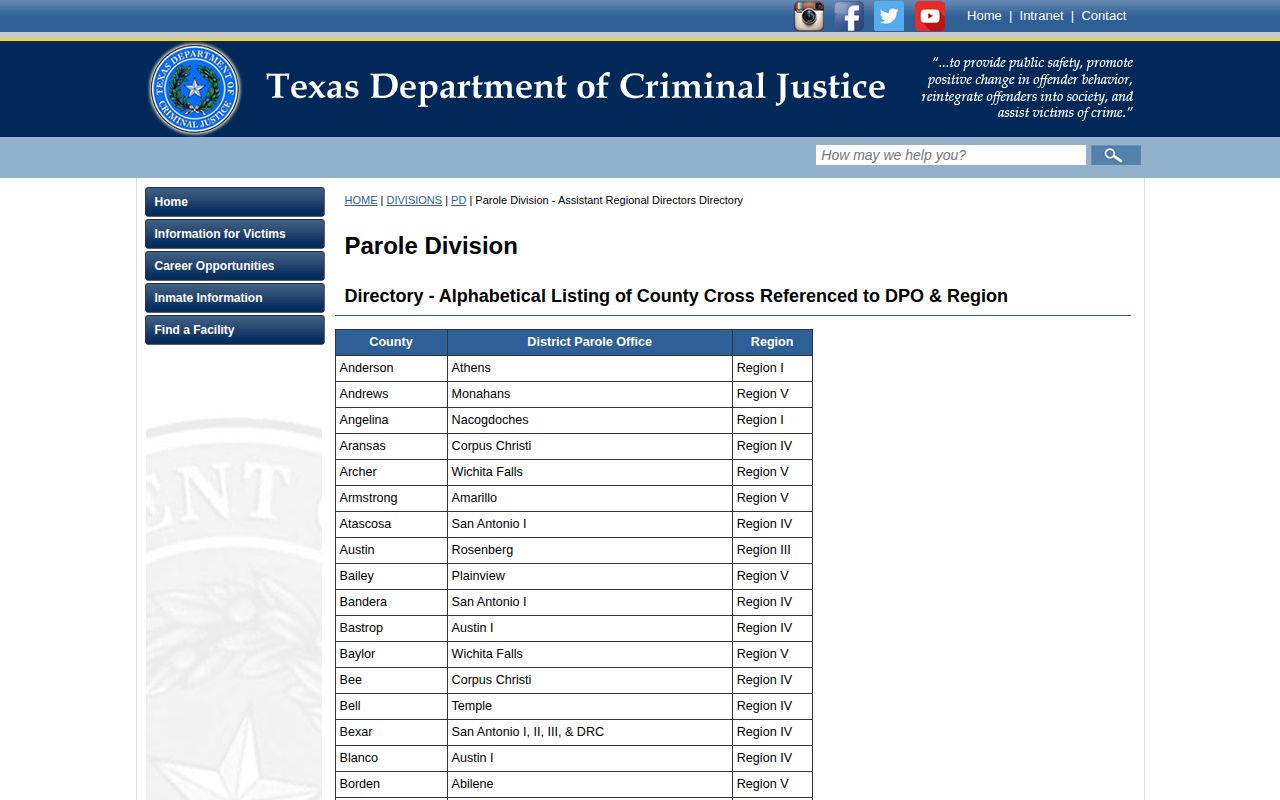
The record must first support parole or mandatory supervision. Only then does the Victoria assignment answer where the case is routed.
100 North John Stockbauer Drive
Victoria, TX 77901
Phone: 361-578-6022
Fax: 361-578-6402
Courthouse Annex, 412 N. Texana
Hallettsville, TX 77964
Mail: P.O. Box 330
Phone: 361-798-4353
Lavaca ISF Completion Records
The 2nd 25th Judicial District Intermediate Sanction Facility adds a third path. It is in Gonzales, not Lavaca County, yet it serves community-supervision cases from Lavaca. TDCJ Community Justice Assistance Division materials list 60 funded male beds. The operator describes court-ordered residence for six to twenty-four months in lieu of placement in a county jail or TDCJ Correctional Institutions Division.
Leaving the ISF is a facility completion or supervision event. It is not automatically a Lavaca County Jail release. Confirm the placement and completion through the sentencing court, the 2nd 25th CSCD, and the facility record. A person may still be under community supervision after departure. If a separate county booking occurred, verify that event on its own record.
That distinction prevents a common error. A residential sanction can limit movement and require compliance, yet it is legally tied to the community-supervision order rather than a new state-prison discharge.
Lavaca Parole Review Results
Texas does not hold a formal, individual parole hearing for each person. The Board’s official explanation says panel members vote the file individually. TDCJ identifies a case before eligibility, an institutional parole officer prepares the case summary, and a three-member panel votes in sequence. Two matching votes decide the result. Review often takes two to six months.
Board meetings and workshops posted on the agency homepage are governance events, not an inmate-by-inmate hearing calendar. Their dates vary. A denial notice includes a later review date. An approval may carry treatment, program, timing, or other conditions. Codes such as FI, NR, and SA should be read through the current Board explanation because a favorable instruction can still require steps before release.
The official TDCJ telephone channel page separates pre-vote, post-vote, and general status contacts. Its captured view reinforces why the stage of review matters.
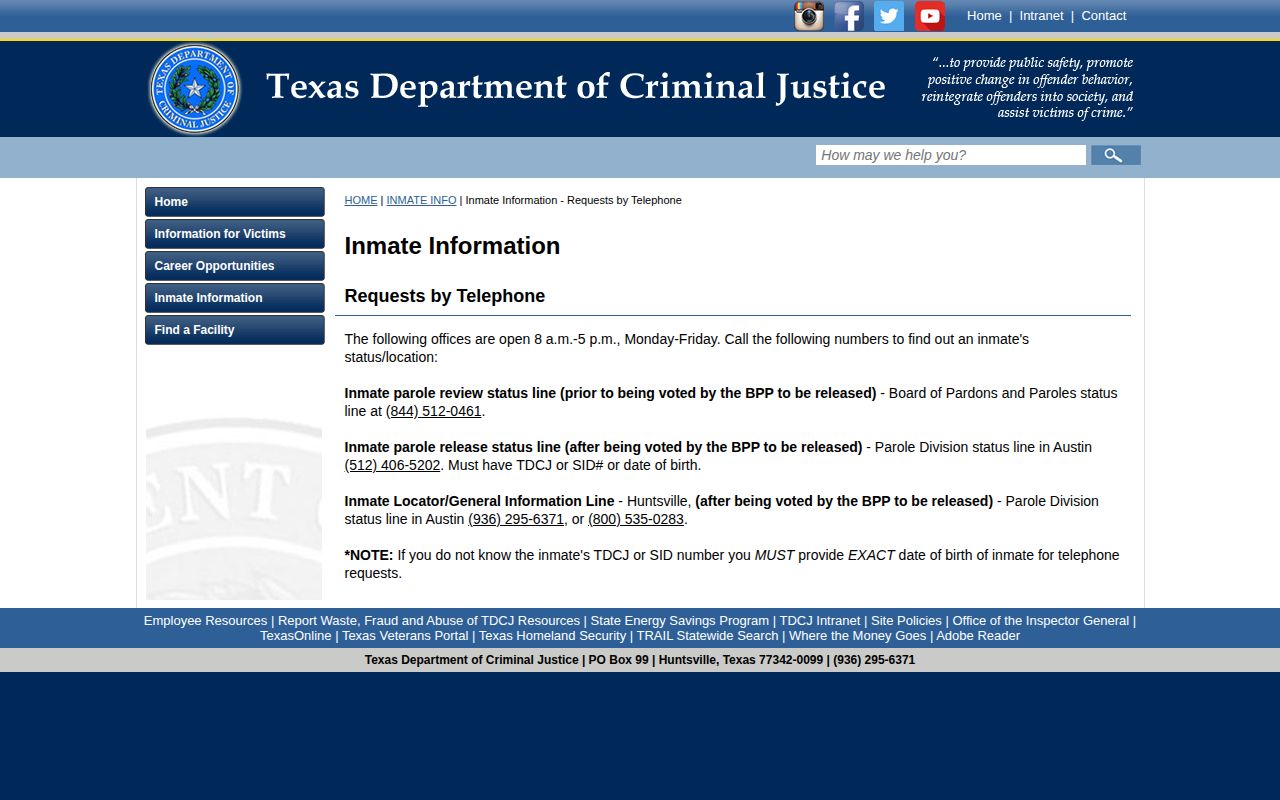
A Board approval supports the next verification step. It does not replace confirmation of the actual release date and destination.
Lavaca Parole Absconder Reports
TDCJ defines an absconder as a parole client who stopped reporting and whose whereabouts are unknown. Its absconder resource provides a 24-hour anonymous tip line at 866-680-6667. That resource is not a searchable Lavaca County warrant list.
A suspected violation does not itself prove a warrant. TDCJ Warrants Section specialists decide issuance and maintain entries in law-enforcement systems. Public absence from an agency page is not proof that no warrant exists. Do not approach a person or turn a record search into a confrontation. Report specific safety or location information through the proper public-safety channel.
Conditions vary by order and may address reporting, residence, treatment, travel, or other conduct. Only the signed order and authorized agency can establish the active terms. A general description cannot show whether one person violated a condition.
Note: State IVSS can provide selected supervision notices, but it is not the official warrant or discharge record.
Lavaca Supervision Discharge Proof
Supervision ends through a recorded discharge, completion, court action, or other lawful termination. A person may also discharge a full TDCJ sentence without parole. Therefore, a missing parole record does not disprove release, and absence from a live inmate search does not prove the sentence ended.
For state cases, compare TDCJ incarceration history, the Board result, the actual release status, and any final discharge record. TDCJ accepts incarceration-history requests by email at pia@tdcj.texas.gov. Supply the full name and seven-digit TDCJ number. If that number is unknown, use exact date of birth, or approximate age and county of conviction. TDCJ states there is no charge for that email information service.
For probation, obtain the judgment and any modification or discharge order from the court that owns the case, then confirm through the 2nd 25th CSCD. There is no verified public Lavaca probationer name search. Court proof plus the local supervision office is the defensible route.
When two sources appear to conflict, compare what each source proves and when it was updated. A jail release date can predate state notification processing. A Board result can precede actual departure. A court order may be newer than an agency status snapshot. Record each event on its own date before treating the difference as an error.
Identity also needs more than a shared name. Compare the TDCJ or SID number, full date of birth, conviction county, court, offense date, and release record. For local probation, use the case number and signed judgment. This reduces the risk of asking an office about the wrong person and makes a records request narrow enough for staff to identify existing documents.
A final discharge record is stronger than online absence. Keep the state sentence, actual release, supervision assignment, and discharge as separate stages. For a local case, keep the probation order, modifications, and discharge order together. That chain shows both the legal basis and the end of supervision without enlarging any single database result.
Notification tools add context, not final proof. TDCJ IVSS covers state prison and parole or mandatory-supervision events. Texas IVSS-Counties covers county custody and is the current successor to county VINE. Neither serves as a public Lavaca probationer search. Select the system that matches the underlying custody, then confirm the result with the signed order or agency record.
For a narrow inquiry, state the person’s identifiers, the status being checked, and the date range. Ask whether a releasable record confirms active supervision or discharge. Do not ask staff to draw a legal conclusion from unrelated records. A precise request is easier to match to an existing file and keeps parole, probation, and jail release events distinct.