
Lavaca Projected Versus Actual Release
A projected date is a calculation based on the sentence, offense rules, credits, and current record. TDCJ uses the exact label Projected Release Date. A scheduled date comes later in the state process, after a release certificate is received and Classification and Records audits the file. The actual date is the day physical custody ends under that record. Only the final event proves the exit.
A pretrial person in Lavaca County Jail does not have a TDCJ projected date merely because a felony charge is pending. Bond, probable-cause review, a court order, dismissal, transfer, or later sentence may change the custody status. For a county sentence, use the judgment, jail credit calculation, and Lavaca release record. For a state sentence, use TDCJ sources.
Find Lavaca Projected Release Dates
Start with the agency that has custody. The TDCJ offender search accepts last name, first name, a seven-digit TDCJ number, SID number, gender, and race. A number is stronger than a name match. The detail for a currently incarcerated person can show location, offenses, and the projected release date. TDCJ warns that the information is at least 24 hours old, updates on working days, and includes only people currently incarcerated in a TDCJ facility.
- Decide whether the person is in the Lavaca County Jail, TDCJ, another county, or federal custody.
- For TDCJ, search by TDCJ or SID number when known and compare the identity and offense fields.
- Read the projected date as an estimate under the current calculation, not a promise.
- For a Lavaca jail sentence, obtain the judgment and credit order from the proper clerk, then ask the jail for its release calculation.
- Near the date, check for a Board condition, new hold, consecutive sentence, or changed unit.
- After the event, obtain the actual release or transfer record.
If a former state prisoner no longer appears, email pia@tdcj.texas.gov for incarceration history. Put the person’s name in the subject and provide the full name plus TDCJ number. If the number is unknown, provide exact date of birth, or approximate age and county of conviction. TDCJ states there is no charge for this email service.
The official TDCJ email information page defines the projected field and the historical request route. Its captured view shows why that channel matters after a person drops from the live search.
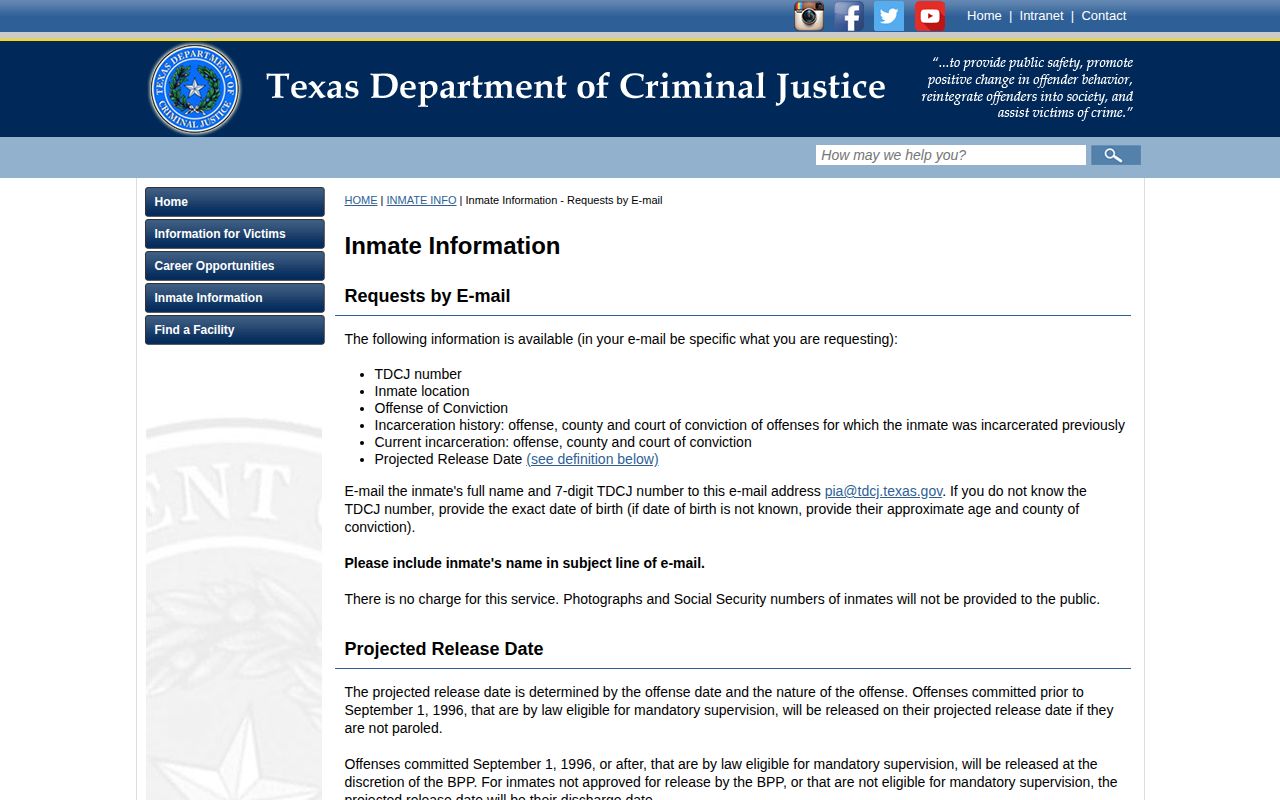
The email history can document state incarceration and dates, but the court and release certificate remain important when the exact legal basis or physical exit is disputed.
Lavaca Good-Time Release Calculations
Texas Government Code Chapter 498 governs good-conduct time. Section 498.003 calls good time a privilege, not a right. It affects eligibility for parole or mandatory supervision rather than shortening the sentence itself. Credits depend on classification and participation and may be lost. State-jail felony sentences have a key limit: good time generally does not create an early release before calendar expiration, apart from a sentencing judge’s limited diligent-participation framework.
Mandatory supervision involves a separate test. Under Government Code Sections 508.147 and 508.149, calendar time plus eligible good time may reach the sentence, but statutory exclusions and Board discretion can control. The exclusion list is detailed and can change. The statute and TDCJ record should govern, not a simple online formula.
A sound calculation begins with the sentence and jail credit. It then classifies the offense and date, applies the correct eligibility law, accounts for allowed credits, adds the Board decision and any program conditions, and checks forfeitures, holds, new cases, or consecutive terms. TDCJ alone maintains the authoritative calculation.
No Texas 85-Percent Rule
Texas has no universal rule that every prisoner must serve 85 percent of a sentence. That shortcut can produce a false date. For offenses listed in Code of Criminal Procedure Article 42A.054, Government Code Section 508.145 generally requires one-half of the sentence or 30 calendar years, whichever is less, in actual calendar time before parole eligibility. Eligibility cannot occur earlier than two calendar years. Other categories follow other rules.
This is an eligibility threshold, not a release date. A person who reaches the threshold is eligible for review, but the Board may deny release or impose a condition. Good-conduct credit does not replace the actual-calendar-time rule for that category. The offense of conviction, offense date, sentence structure, and current law all matter.
Older records may still call Article 42A.054 cases “3g” offenses. That label refers to the former location of the rule. It should not be read as a percentage formula.
Why Lavaca Release Dates Move
A projected date can change while every agency record remains accurate for its own timestamp. TDCJ may recalculate credits, receive a new judgment, record a disciplinary forfeiture, or learn of another hold. A favorable Board vote can include a program condition. The release certificate must then be audited before a scheduled date and unit are fixed.
| Factor | Effect on the date or destination |
|---|---|
| Good-time gain or loss | May change parole or mandatory-supervision eligibility. |
| Board decision | Approval, denial, reconsideration, or a program condition changes the next step. |
| Detainer or hold | Another agency may receive the person even when TDCJ custody ends. |
| New or corrected court order | Sentence length, credit, or consecutive terms may be recalculated. |
| Release-certificate audit | The scheduled date or release unit may change before departure. |
| Transfer | The county or state booking may end without a community return. |
TDCJ says that after the release certificate arrives, its audit and scheduled-date calculation may take about 14 to 21 business days. It also warns that dates and locations can change without notice. Recheck before travel.
Lavaca Jail Release-Date Records
Do not apply the TDCJ formula to a Lavaca County Jail stay. A local detainee may be awaiting trial, serving a county sentence, or waiting for transfer. The court judgment, jail-credit order, local calculation, and release or transfer order control. No official Lavaca jail good-time policy was found.
The Sheriff-linked Released database records admit date, release date, and time in jail for a closed booking. It does not visibly state the release reason. A bond line does not prove bond caused the exit. Request the booking-out sheet, exact release time, release manner, destination or receiving agency if recorded, and related release or transfer order.
Article 17.033 includes prompt-release protections for some warrantless arrests when probable cause is not determined on time. Those legal clocks are not good time. They also have no connection to entering one or three in the website’s Days filter.
Lavaca court records help explain the authority for release. District Clerk records cover felony and district matters, while County Clerk records cover county-court misdemeanors. The court file may contain the judgment, sentence, bond order, dismissal, or credit ruling. Yet it may not show the exact hour the person left. Pair the court document with the jail’s booking-out record. The jail register is retained permanently under the state schedule, while booking-out and release or transfer documents have a minimum release-plus-two-year retention period. Web disappearance is not record destruction.
Confirm Lavaca Actual Release Dates
For a state case before a Board vote, call 844-512-0461. After a favorable vote, call TDCJ Review and Release Processing at 512-406-5202. General location help is available at 936-295-6371 or 800-535-0283 on weekdays from 8 a.m. to 5 p.m. The caller needs a TDCJ or SID number or exact date of birth.
TDCJ IVSS is a separate state-prison and parole notification system. The official state IVSS portal can provide selected release and supervision notices. The captured landing page shows the distinct state channel.
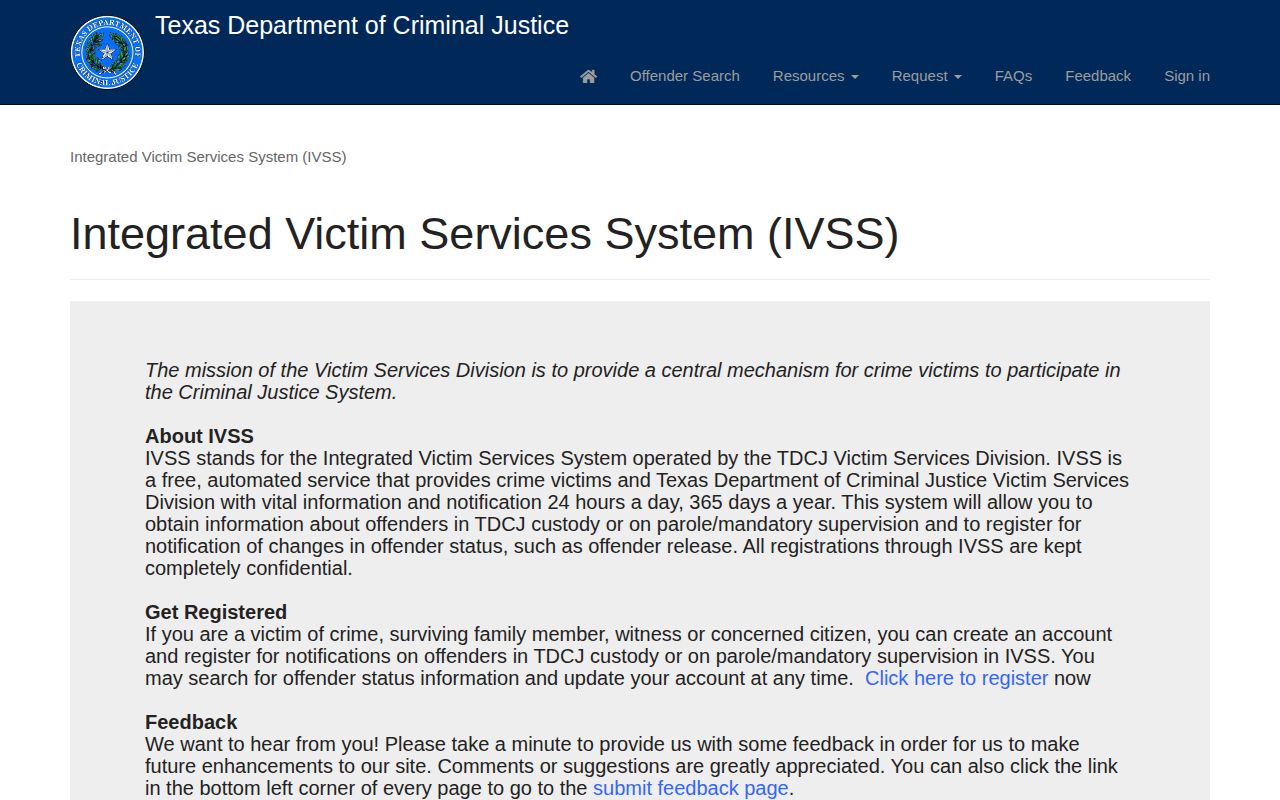
An alert is useful corroboration, but it does not replace the actual release certificate, discharge history, or receiving-agency record.
For county custody, call Lavaca County Jail at 361-798-2420 and request the booking-out or transfer record when the online date is missing or unclear. For a state case, preserve the projected date, Board result, scheduled status, and final discharge record as separate facts.
A passed projected date deserves a fresh check. It may have moved because of a Board decision, hold, new sentence, credit change, or audit. If the person has vanished from the current TDCJ search, use incarceration history rather than assuming the estimate became actual. The VINE Inmate Check page explains the separate county and state alert systems.
Other custody systems require their own date evidence. A BOP locator release date means the person is out of federal Bureau of Prisons custody, not necessarily free of supervision or another hold. ICE states that its locator can include people released within the prior 60 days, but disappearance after that display period proves little. A Lavaca jail release followed by another agency’s custody entry can be a transfer rather than a return to the community.
When sources disagree, write down each source’s scope and timestamp. TDCJ data may lag, a court order may be newer, and an alert may arrive before the county display changes. Match identity through numbers, date of birth, court, offense date, and booking information. A photo can help, but it should not stand alone.
Keep a clear date trail. Save the projected date with the date it was viewed. Note the Board result and any stated condition. Record when the scheduled date was confirmed. After departure, request the actual release or transfer entry. If the person moved to another custodian, add that agency’s reception record. This sequence shows why an older estimate changed without erasing the earlier snapshot.
A records request should seek existing documents, not ask staff to calculate a hypothetical date. For Lavaca County Jail, identify the booking and request the jail calculation, booking-out sheet, and release or transfer order. For TDCJ, identify the person by number and request incarceration history or the releasable release record. For a court issue, ask the clerk for the judgment, sentence, credit order, and later modifications.
Family travel plans should wait for direct confirmation. No fixed Lavaca jail exit, release hour, weekend schedule, or waiting area was published. Call the jail before travel. TDCJ likewise warns that a release unit may change. A projected date can guide follow-up, but it should not be the sole basis for arranging a pickup.